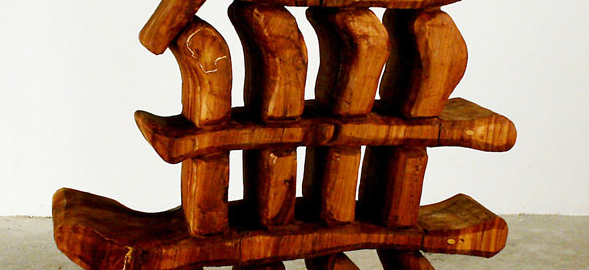
Chinese wu (traditional Chinese: 無; simplified Chinese: 无) meaning “not have; without” is a keyword in Buddhism, especially the Chan and Zen traditions. The Chinese word wu 無 “not; nothing” was borrowed by East Asian Languages, particularly the Sino-Xenic “CJKV” languages of Chinese, Japanese, Korean, and Vietnamese.
Some English translation equivalents of wu or (Japanese) mu 無 are:
In modern Chinese, Japanese and Korean it is commonly used in combination words as a prefix to indicate the absence of something, e.g., Chinese: 无线; pinyin: wúxiàn / musen (無線?) / museon (무선 ) for “wireless”. In Classical Chinese, it is an impersonal existential verb meaning “not have”. [Our comment: Wu / Not have as part of digital connection in super-productive online times is quite a fun twist 🙂 ]
The character wu 無 originally meant “dance” and was later used as a graphic loan for wu “not”. The earliest graphs for 無 pictured a person with outstretched arms holding something (possibly sleeves, tassels, ornaments) and represented the word wu “dance; dancer”. After wu 無 “dance” was borrowed as a loan for wu “not; without”, the original meaning was elucidated with the 舛 “opposite feet” at the bottom of wu 舞 “dance”.
We want to humbly point out that the concept of doing nothing was not invented by us, but rather fowarded and “copied”, put into “action”. We practically want to find out more about an ancient Taoist principle, without necessarily becoming Taoist: Wu wei (Chinese: 無爲; a variant and derivatives: traditional Chinese: 無為; simplified Chinese: 无为; pinyin: wú wéi; Japanese: 無為; Korean: 무위; Vietnamese: Vô vi; English, lit. non-doing) is an important concept in Taoism that literally means non-action or non-doing.
[curated with the least effort possible from wikipedia]
Michael Roselieb made the impossible tangible. A 150 kg Wu. We kindly invite you to appreciate his work at
www.michaelroselieb.com
&
www.michaelroselieb.com/objects.php?kind=chinese-characters